October 10, 2025
Dear Orrville Residents,
As your superintendent, I write to you not as a politician, but as a parent and steward of the education system that lies at the heart of Orrville. Like you, I open my property tax bill with concern. And like you, I want our community to remain strong, vibrant, and affordable. Today, I want to share the broader picture of how Ohio funds its schools and why it matters for all of us.
The Numbers Don’t Lie: Ohio Has Shifted the Burden to You
Over the past two decades, state lawmakers have made gradual choices that have dramatically changed how Ohio funds education—and who pays the bill.
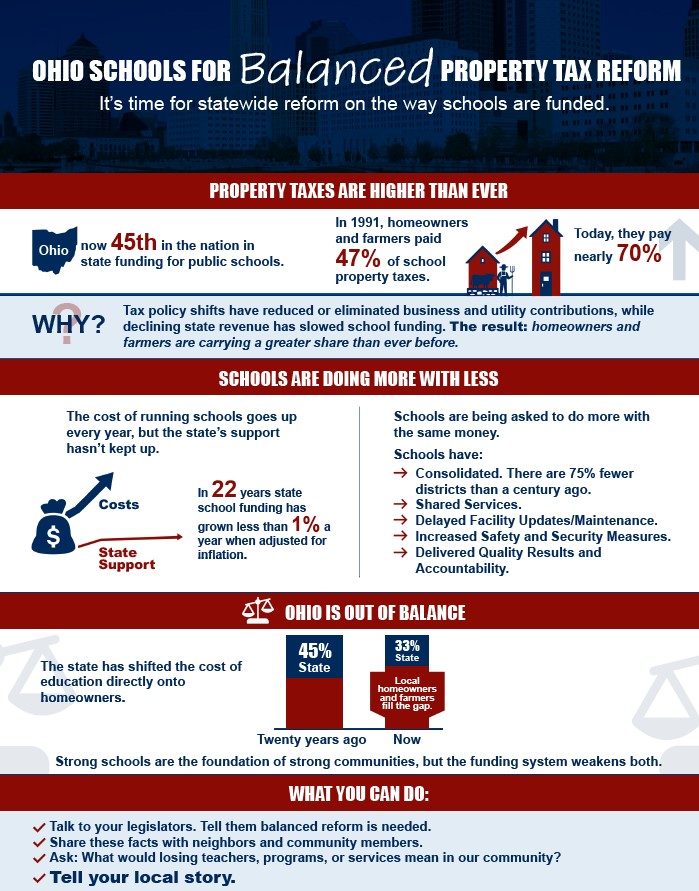
- In 2002, Ohio ranked 35th nationally in state funding for K-12 education.
- By 2023, Ohio had fallen to 45th, among the worst in the nation.
- The state share of education funding dropped from 44.8% to just 33.5%, while the national average remains around 45%.
- Local property taxpayers—homeowners and farmers—are now covering nearly 70% of school funding, compared to 47% in 1991.
This change doesn’t mean Ohio is overspending on education. In fact, Ohio ranks only 20th nationally in per-pupil spending. What’s changed is how the cost is divided. Instead of the state carrying its fair share, local homeowners are being asked to make up the difference.
This Affects More Than Just Schools
Strong schools are the foundation of strong communities. Property taxes don’t just fund classrooms; they help sustain the very services that keep Orrville a place we are proud to call home: safe schools, responsive emergency services, and a strong infrastructure. If we want to keep Orrville thriving, we cannot allow state disinvestment to weaken what we have built.
Our Children Deserve Better
Every child in Orrville deserves excellent teachers, safe schools, and educational programs that prepare them for the future. These are not luxuries; they are investments in our shared future. The reality is that our schools have already achieved more with less by collaborating with various consortia to reduce operational expenses, defer facility upgrades and maintenance, and enhance safety and accountability measures. Despite these efforts, the state’s support has not kept pace with rising costs, leaving the burden on our local community.
Current Legislative Proposals
Our legislators have been introducing a plethora of bills to address property tax reform. We concur that our communities require property tax relief and that property tax reform is long overdue. However, as a district, we are asking our legislators to team up with local communities in these reforms to make changes that address these needs while still supporting your local schools.
Orrville currently has two emergency levies. These are fixed-sum levies that were passed to support the district's operations and have been renewed by the community. Together, they make up approximately $2.7 million in yearly revenue for our district. Legislators aim to modify these levy types and their calculation into other district levies, as well as the 20-mill floor calculation. This recalculation would result in these dollars being absorbed into general operating levies, ultimately leading to their loss in future reappraisals. We ask that these levies remain as they are, but if recalculation is necessary, please phase them in at the levies' renewal in future years. This proposal would allow the district to properly plan for revenue adjustments. Current legislation would include these in the 2026 reappraisal, which does not provide adequate time for operational planning.
Additionally, House Bill 186 includes a retroactive property tax provision that would look back in time to allow arbitrary credits to be given in future tax years. The Ohio Association of School Business Officials has calculated that this would result in a loss of $1.1 million to Orrville Schools in tax years 2026 and 2027. Again, we ask for sound reform that allows our district to plan responsibly for these changes.
A Call for Real Solutions
We cannot fix this challenge by simply shifting more costs onto local property taxpayers. Real solutions must include:
Targeted Relief for Those Who Need It Most
- Expanded property tax relief for seniors on fixed incomes.
- Additional exemptions for citizens with disabilities.
- Strengthened homestead exemptions for low-income families.
Sustainable Growth Protections
- Revenue growth limits to prevent unsustainable tax increases.
- Caps tied to inflation and income growth.
- Triggers for community review if increases exceed reasonable thresholds.
Local Control and Transparency
- Greater flexibility for communities in structuring abatements and exemptions.
- Transparency in how incentives are granted and monitored.
Moving Forward Together
The path forward requires all of us—residents, educators, and elected officials to work together in demanding that Ohio step up to its responsibility to fund public education. Other states have found a better balance. Ohio can too.
For additional context and information, please see the diagram below, which outlines how Ohio’s funding system has shifted more of the tax burden onto local homeowners.
Thank you for your continued support of Orrville City Schools and for being a community that always puts children first.
Sincerely,
David M. Toth
Superintendent, Orrville City Schools